
Pithora (Chhattisgarh) [India], December 4: Ravi Kumar along with 39 other labours was doing what highway maintenance workers do every morning—preparing to trim overgrown grass along the National Highway 53 divider. He was reaching for his trimmer when the white sedan crossed into his lane at 110 km/h. The driver was asleep. Kumar, focused on his work, had three seconds left.
Then physics intervened.
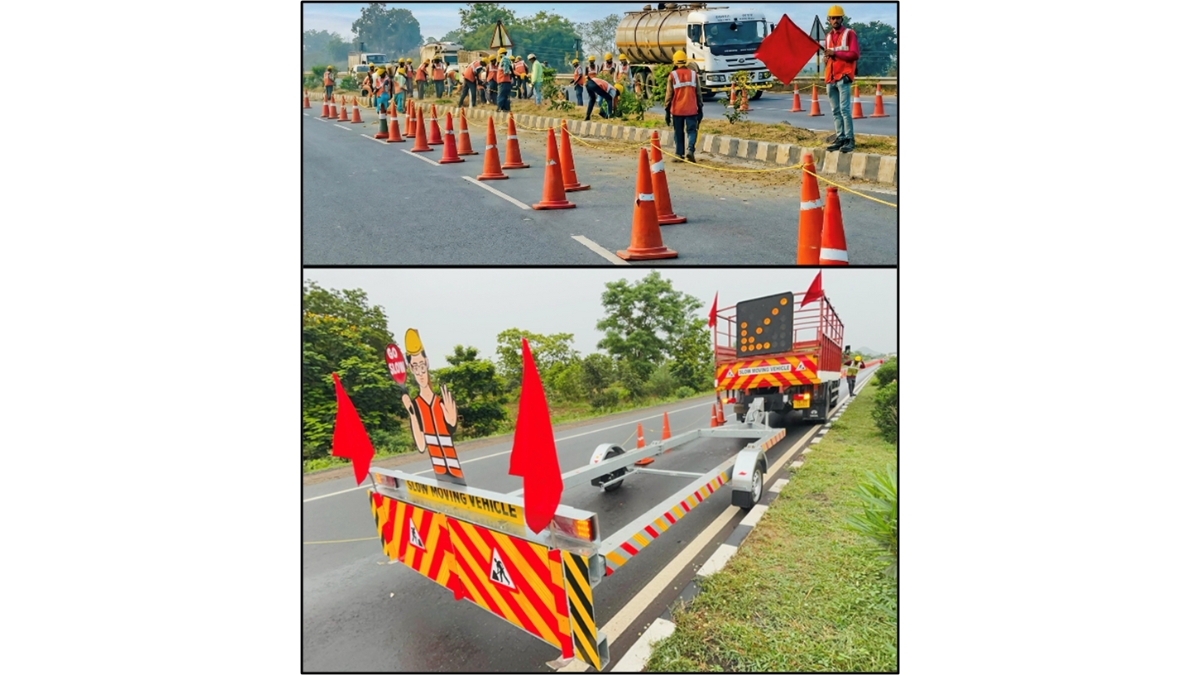
What Stood Between Life and Death
At exactly 9:28 AM, a Trailer Truck Mounted Attenuator (TTMA)—engineered by Germany’s Nordic Traffic Safety under Managing Director Mr. Andreas Lau and assembled in Bhilai, Chhattisgarh—absorbed an impact that should have killed dozens.
When collision came at 110 km/h, the TTMA’s energy-absorbing cartridges crushed inward with mathematical precision, dissipating enough force to kill multiple people within three heartbeats. The dashcam captured everything: violent impact, controlled destruction, and then—impossibly—the driver stepping out of his mangled car without a scratch. Forty workers continued their shift, completely unaware they’d just escaped mass tragedy.
The equipment was produced through technical collaboration between Nordic Traffic Safety and Bhilai-based Jai Enterprises, where Partner Mr. Harsh Ketan Vira has established domestic assembly operations. Bhilai’s geographic location in central India—equidistant from Mumbai, Delhi, Kolkata, and Chennai—means spare parts can reach any major highway within 24 hours rather than the 3-6 month delays typical of imported equipment.
The Economics That Demand Policy Action
India loses approximately 3% of GDP—roughly ₹15 lakh crore annually—to road accidents. Over 29,000 people died on national highways in just the first six months of 2025. National highways comprise just 2% of India’s road network but account for 30% of all traffic fatalities.
Each fatal crash costs upward of ₹50 lakh. The NH-53 incident alone prevented an estimated ₹2+ crore in accident costs. Yet TTMAs remain optional equipment rather than mandatory safety infrastructure for highway work zones.
The technology meets international MASH TL-3 safety standards. Domestic manufacturing capability exists. The economic case is proven. What’s missing is policy-level intervention to mandate deployment across India’s expanding highway network.
A Template for Nationwide Implementation
Road safety experts reviewing the NH-53 footage note that work zone accidents killed over 200 maintenance workers on Indian highways in 2024. Most involved vehicles striking workers directly—exactly what TTMAs prevent.
With domestic assembly from India’s geographic heartland eliminating import delays and providing immediate technical support nationwide, the infrastructure for mass implementation already exists.
What Happens Next
Forty workers went home safely that evening. Forty families remained intact. One drowsy driver got an unexpected second chance.
The dashcam footage circulating among highway safety officials demonstrates what’s achievable with existing technology and manufacturing capability. The question now moves from technical feasibility to policy will: making proven protection mandatory rather than optional.
The technology exists. The manufacturing is established. Policy intervention can make November 26’s miracle the standard, not the exception.
About Made in India TTMA (Trailer Truck Mounted Attenuator)
These TTMA crash attenuators are assembled in India by Bhilai-based Jai Enterprises through partnership with Germany’s Nordic Traffic Safety, meeting international safety certifications. Deployed by Macquarie Group for toll operations, these Made-in-India units provide highway authorities immediate access to life-saving equipment. Highway operators seeking deployment details can reach Jai Enterprises at [email protected]
Video Link: https://youtu.be/jk3SIs1tMHE?si=eWvm7ne5lnoCzgjD
If you object to the content of this press release, please notify us at [email protected]. We will respond and rectify the situation within 24 hours.
 English